
Social media’s influence extends beyond traditional networks like Twitter and Facebook. It also plays a significant role in niche areas, including online wagering communities. These communities thrive on interaction and engagement, much like any other online social network. They depend on social media to connect, share consumer experiences, and build a sense of camaraderie among users.
Since 2023, growing concerns around data use, moderation practices, and platform governance have reshaped how users evaluate social platforms. Changes in Twitter’s ownership and policies, combined with new regulatory scrutiny in the EU and elsewhere, have pushed many users to actively seek alternatives that offer clearer rules and stronger privacy protections.
Moreover, the recent developments around Twitter’s policies, content moderation struggles, and threats to privacy rights have raised serious concerns for many users. As Twitter continues to centralize control and makes questionable calls regarding transparency, free speech limits, and data collection, the clamor for ethical alternatives keeps growing. This growing demand for ethical and privacy-focused platforms extends beyond social media, influencing other digital spaces such as online casinos, where user trust and data protection are equally critical.
Privacy Matters: Social Media and Online Casinos Alike
In Canada, especially in Ontario’s regulated iGaming market, operators are now required to follow clear data-handling standards, including consent, security controls, and transparent privacy disclosures. Trusted names like PlayOJO and LeoVegas are setting an example by adopting robust privacy measures to ensure users’ data stays safe and is managed transparently.
Similarly, resources dedicated to Ontario online casinos for real money help find trusted websites with strong user protections. These platforms offer detailed reviews, helping players compare casinos based on factors like security, game variety, and payment options. They also guide users on how to recognize reliable sites that meet strict standards for fairness and transparency. Both areas highlight a growing trend where ethical practices and openness are no longer just optional but essential in online interactions.
This shared emphasis on user privacy and ethical practices highlights the importance of exploring platforms that empower individuals without compromising their rights, particularly as the demand for alternatives to traditional networks like Twitter continues to grow.
Across both social media and online gambling, the common trend in 2025 is simple: users expect platforms to explain how data is handled, why it is collected, and how they remain accountable.
 It became apparent that an in-depth look at the ecosystem of social platforms prioritizing user rights without compromising connectivity was needed. We set out to shine a light on networks attempting to facilitate expression and association without accruing disproportionate corporate power or exploiting personal data. Below, we dive deep into the spectrum of ethical and user-empowering social networks beyond Twitter seeking an alternate vision for social media’s future.
Why Are Users Leaving Twitter for Other Platforms?
People are leaving Twitter for other social networks because they worry about how safe their personal information is on Twitter.
In May 2022, Twitter agreed to pay a USD 150 million settlement to U.S. regulators after allegations that phone numbers and email addresses collected for account security were used for targeted advertising. While this enforcement action is not new, it remains a widely cited example in discussions about platform trust and privacy.
Between 2023 and 2025, many users began exploring decentralized or protocol-based networks that offer greater control over identity, feeds, and data portability. They are increasingly choosing networks such as Mastodon, Diaspora, and Bluesky, which emphasize open protocols, decentralized governance, or user-controlled identity. Unlike Twitter, these networks don’t use consumer information for things the user hasn’t agreed to. Users are moving to these new platforms because they want to feel safe and know that their personal data is not being misused.
Overview of Twitter Alternatives
Let’s start by briefly introducing some of the major alternative social platforms available today:
- Mastodon is a decentralized, open-source microblogging network. Its federated architecture allows independently operated servers to interact with a common protocol. This means no single entity controls the network. Mastodon emphasizes freedom of expression within an inclusive community framework.
- Diaspora consists of interconnected social pods run by different groups and individuals. Like Mastodon, it’s decentralized but focused on providing a Facebook-like sharing experience for friends and communities. User privacy is a key priority.
- Friendica functions as a fusion of Facebook, Twitter, and email. Its features facilitate both public and private communication between both individuals and groups. The platform values privacy while encouraging polite discourse.
- GNU Social is a continuation of the privacy-centric StatusNet project under free software ideals. Its goal is to offer ethical public and private communication aligned with user rights. It interoperates within the fediverse.
- Minds offer encrypted communication in an open-source environment. It aims to provide fair monetization to users through its token rewards program. Features like boosted content and groups foster community engagement.
- Gab positions itself as a minimal-moderation platform emphasizing free expression. However, its reach in 2025 is limited by payment processor restrictions, app store availability issues, and advertiser withdrawal.
- WT Social operates as a nonprofit focused on civil discourse and information quality. While still active, its overall activity level is significantly lower than newer alternatives.
- Bluesky is a decentralized social network built on the AT Protocol. By 2025, it has become one of the most discussed Twitter alternatives, particularly among journalists and researchers, due to its open identity system and customizable feeds.
Nitter – Top Twitter Alternative Among Consumers
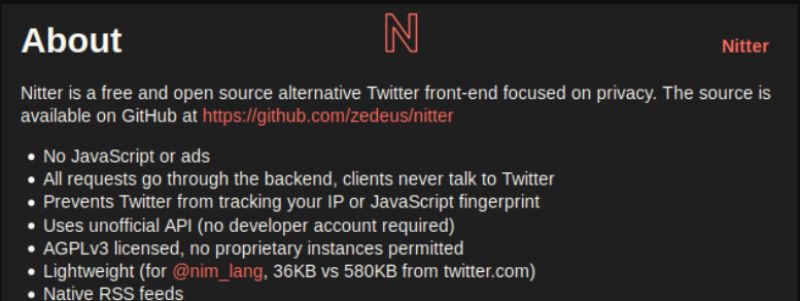
Nitter is an open-source alternative Twitter front-end designed to let users view Twitter content without logging in or exposing tracking data.
What is Nitter?
Nitter is an open-source alternative Twitter front-end developed by creator Zedeus. First launched in 2019, it has been widely used by privacy-focused users for accessing Twitter content without direct tracking.
Nitter operates by routing all requests through its backend instead of connecting users directly to Twitter’s servers. This allows it to shield user IP addresses and other identifying data from being logged by Twitter.
Since early 2024, many public Nitter instances have become unreliable or inaccessible after Twitter (X) restricted guest account access and anti-scraping measures were introduced. As a result, Nitter’s availability in 2025 is inconsistent and depends on individual instances.
Why We Like Nitter
Nitter offers a streamlined experience that loads far faster than Twitter itself while letting users customize its interface. And unlike Twitter, it comes with no ads or bloatware to hamper performance.
Specific advantages that make Nitter our favourite include:
Privacy Protection
- Accesses Twitter without exposing IP or identifiers
- Backend routing cuts off Twitter’s tracking ability
- Aligns with ethics of user privacy rights
Customization & Performance
- Streamlined interface loads faster than Twitter
- Allows UI customization through themes
- Ad-free experience improves performance
Transparency & Expandability
- Open source code enables transparency
- Contributors expand features aligned with privacy
- Roadmap includes additions like account integration
Convenience
- Adds functionality like RSS, embeds, archiving
- Expands Twitter access minus the tracking
- Hits the sweet spot between utility and user rights
For an ethical Twitter experience that respects consumer privacy and doesn’t undermine personal agency, Nitter is an excellent choice. Its current features and future roadmap make it our favourite front-end alternative.
In 2026, Nitter is best described as a useful privacy tool when accessible, rather than a dependable long-term alternative to Twitter itself.
Key Attribute Comparison of Twitter Alternatives
Platform availability, moderation models, and feature sets continue to evolve. Users should expect variation based on server choice, jurisdiction, and ongoing regulatory changes, particularly under frameworks such as the EU Digital Services Act.
| Platform | Key Features | Privacy/Data Control |
|---|---|---|
| Mastodon | – Decentralized servers – Diverse communities – Open source | – Strong default privacy – User data ownership – Prevents unilateral policy changes |
| Diaspora | – Encrypted messaging – Granular audience control | – No unencrypted admin access – Extensive account control tools |
| Friendica | – Integrates multiple platforms – Group messaging | – Separate contact storage – Strict limited admin access |
| GNU Social | – Public and private options – Fediverse integration | – Avoids collecting private user info |
| Minds | – Tokens for monetization – Encrypted messaging | – Minimal necessary data access – Ledger provides transparency |
| Gab | – Near-absolute free speech | – Minimal governance model |
| Tumblr | – Multi-media content creation – Custom themes | – |
| WT Social | – High information quality – Civil discourse tools | – Non-profit pledge to not sell data |
| Nitter | – Themes – RSS feeds – Embeds | – No direct Twitter access – Cuts off user tracking |
Editorial Note (2025–2026): This article reflects platform conditions and regulatory developments up to early 2025. Social networks, moderation policies, and access models change frequently. Readers are encouraged to verify platform availability and privacy terms before adopting any service.